On A Royalty Payment

J.M. Barrie is fondly remembered as the creator of one of the most loved children’s fictional characters: Peter Pan. Born in the year that the American Civil War began, during the Victorian Era in Britain, Barrie lived to see the rise of Hitler and Mussolini and the spread of things like radio and automobiles. He first published Peter Pan in 1904 as a play and soon had it made into the book that generations since have known and loved.

And such a popular story meant that the author, too, was popular. Until his death in the late 1930s, J.M. Barrie was asked by people of all backgrounds to meet their children, to tell them stories, and to entertain youngsters with his tales of children who never grew up. He was constantly receiving invitations to children’s birthday parties and other events such as tea parties and holiday gatherings, where it was expected that he would read from one of his stories or otherwise provide entertainment for the young folks gathered for the occasion. Three year old Margo and her big sister were two of the children that Barrie got to meet over the years.

These girls were the children of some wealthy people who had imposed upon Barrie to make an appearance at Margo’s birthday party. In fact, the old man was escorted to the table where he found himself being seated next to the guest of honor herself. And, as he always did, Barrie quickly established a rapport with the young children. They knew who he was, but it was his quirky and funny manner that drew then to him. They liked that he didn’t talk down to them as so many adults did, but, rather, he engaged them as equals, asking questions of them and appreciating their answers.

Barrie noticed that, despite the obvious wealth of Margo’s parents, the presents that lay before the birthday girl seemed like they had come from a typical department store such as Woolworth’s. He pointed to one of them and said to Margo, “Are those presents yours?” The precocious three year old eyed the old man and replied, “Well,” the child said thoughtfully, “let’s say that they are yours and mine.” Barrie was thrilled. Later on during the party, when some other adult asked Margo about her interactions with the old man. Barrie was again enthralled when he heard the child’s response.

“He is my greatest friend, and I am his greatest friend.”

Barrie practically ran home and wrote about his interaction with this charming and well-spoken child, a young girl whose poise and vocabulary were far beyond her three years. He later added these interactions to another of his plays almost verbatim. And, being a gentleman, Barrie also contacted a barrister. He asked the man to create a contract that credited young Margo with the lines that Barrie used in the play. He insisted that his young muse receive proper compensation for the inspiration she provided to him.

Barrie then had another reason to visit the family and young Margo and her older (and much quieter) sister. He presented the legal document that asked permission for Barrie to use the lines to Margo and her parents, and they though at first that he was having a laugh. Barrie persisted; he was completely serious. To prove it, the author produced a dark canvas bag that held 170 gold pennies as payment for him to have used her words.

We have the contract, still today, and it contains three signatures. One is, of course, that of J.M. Barrie. The other two are the mother, a woman named Mary, and then there was that of Margo, but she signed the document using her formal name and not the name that her family called her:

Princess Margaret, the younger sister of the quiet one–the quiet one who would go on to be Queen Elizabeth II.

On a Nervous Singer

The room began to fill with partygoers, and the sight of all those happy people coming into the union hall gave Ethel the shakes. “Why?” she said to herself; “why would I agree to sing at a New Year’s Eve party in front of total strangers?” The 18 year old girl retreated to a corner of the hall in an attempt to steel her nerves.

A young man with a pencil-thin mustache noticed her sitting in the corner, twisting her handbag in obvious distress. He approached her and asked, “What’s going on with you then?” Ethel looked up quickly. “Hmm?” she asked. He repeated his inquiry. “What’s going on?” Ethel glanced around the young man and pointed to the incoming crowd of revelers. “That. Them. Those people. That’s what’s going on. I agreed to sing tonight, but now, I’m not so sure.”

“Well, can you sing at all?” the young man asked. Ethel looked up at him a bit surprised. “Well, yes. A bit,” she said. “Then, what’s the trouble?” he wondered, and he pulled up a chair and sat next to Ethel.

She looked at him closely. He was somewhat handsome, she thought, with kind eyes behind his round eyeglasses, and he wore a nice smile. “I guess it’s nerves,” Ethel explained. “This’ll be the largest crowd I’ve ever performed for.

It was New Year’s Eve, 1935, and the Union Hall in New York City was buzzing with excitement. The Great Depression had put a damper on such celebrations in recent years, but the Roosevelt New Deal programs had begun to have a positive effect in some segments of American society by that point. The Union Hall was where what we today might refer to as socialists would meet to discuss how they could help affect even more change in the capitalist system. As they saw it, the moneyed interests represented the biggest culprit in the crushing of the American worker underfoot in recent years. The hall that night was filled with other, young and idealistic young people who put economic theory on the backburner for one moment and wanted simply to have a good time and welcome in what they hoped would be a better year to come for their cause.

And Ethel had agreed to sing. And now she was having second thoughts.

Well, the young man calmed her down. He politely excused himself and returned in moment with a drink that Ethel gladly accepted. She gulped it down, and he smiled at her. “Say, let’s go there (he pointed at this point to a nearby room), and you can sing to me to practice. It might also calm you down some.” Ethel smiled and agreed.

And it worked. Ethel sang that night, but she was singing to her new friend, the young man with the nice smile and the kind eyes and the round glasses and the dapper mustache. And he was waiting for her when she came off the stage to a nice round of applause.

“What’s your name?” he said over the clapping. “Ethel,” she answered, “Ethel Greenglass. And what’s yours?”

The man who would become her husband three years later, the man who would become the father of her two sons, and the man who would seal her fate, answered.

“Good to meet you. I’m Julius Rosenberg.”

On Finishing the Race

Shizo Kanakuri finished a marathon in Stockholm, Sweden, in 1967. That in itself isn’t terribly remarkable. One thing that was remarkable about it was that Kanakuri was 76 at the time. But the reason the Japanese citizen finished that race is a story in itself. You see, when he was a young man, Kanakuri had been one of Japan’s premier marathoners, a person who set international records in the sport.

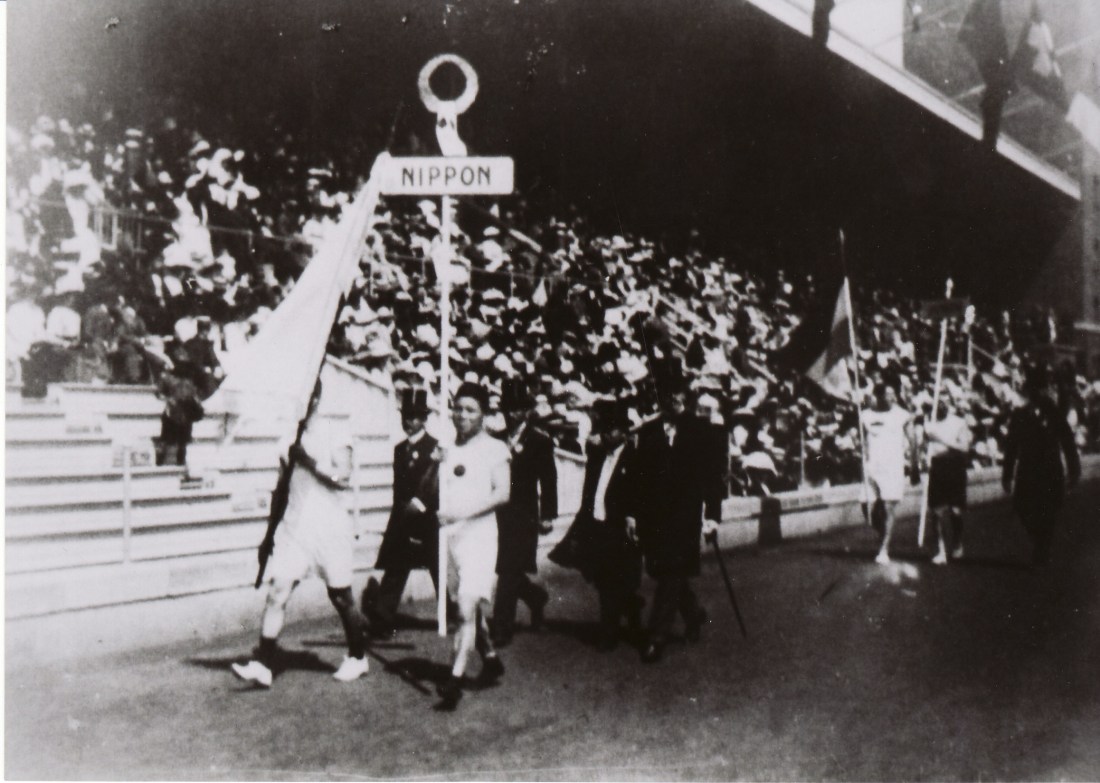
In fact, Kanakuri had been in Sweden years before. In 1911, he and one other Japanese runner had received their nation’s blessing to represent the empire in the 1912 Stockholm Olympics. As a college student, he and his fellow runner had little funds to pay their way by boat and train across Asia to compete in the games. A national fundraiser among other college kids collected enough money to sent the pair to the Scandinavian capital city.

The journey took 18 days of really uncomfortable starts and stops aboard the rail system of pre-war Russia across Siberia. The trip was so difficult that it took Kanakuri almost a week to recover when he arrived at the games. Then, upon arrival, he had to deal with the disorienting affect that the ever-present Swedish summer sun had on his psyche. The only food available was completely unusual to him. Add in a freak heat wave that set records for Stockholm. Then, his coach came down with tuberculosis, leaving the young man without any advice or training prep for the race. All of these factors caused Kanakuri to be completely unprepared for what should have been his defining sports moment.

It all proved too much for the young man. Halfway through the marathon, Kanakuri…simply stopped.

He knocked on the door of the house of a family who lived along the race course. They took him in, gave him water, fed him, and let him rest. Too embarrassed to admit that he dropped out of the race, the young man decided to tell no one that he had quit–not his team, race officials, or anyone else. He slinked back to Japan secretly and quietly. For many years, he beat himself up emotionally for having never finished the race and then stole away without telling anyone. Some reports even came out of Sweden that the runner had simply vanished since no word had ever been received about what had happened to him.

Now, fast forward to 1967, some 55 years later. Kanakuri was invited by Stockholm athletic authorities to complete the race he started but never finished. In doing so, he set a record for running a marathon. In fact, to be exact, Shizo Kanakuri finally crossed the finish line of the 1912 Stockholm Olympic Games in a time of 54 years, 8 months, 6 days, 5 hours, 32 minutes, and 20.3 seconds. Along the way, he later said, he got married, had 6 kids and 10 grandchildren.

But he finished the race.

On Finding a Knife

Osoyro, Norway, lies on the western edge of the Scandinavian nation, on the water, and is one of hundreds of little, picturesque villages that dot the inlets and bays of the coast. It boasts a population of around 1,500 hardy and healthy and happy souls.

Elise is an 8 year old student at the local elementary school. She’s really a typical kid; she loves horses and flowers and her friends. She’s a decent student, and she loves her pets. But something happened to Elise this year in school that doesn’t happen too often these days.

We have all heard the stories about school violence, especially in the United States. Outbreaks of attacks have been increasing in occurrence across the globe, sadly. In nations where guns are as readily available as they are in the US, even knife attacks have seen a rise in many schools. In an effort to combat this rise in violence, some schools have been encouraging kids to report incidences where they witness a classmate with a potential weapon. This preventative measure has met with a mixed reaction. Kids are not eager to be seen as tattle-tales, squealers, or rats. They want to be liked. On the other hand, if one attack is thwarted because some brave child reported a potential threat, then the program is worth it in my eyes.

Anyway, Elise and her friends were on the playground one day (yes, kids go outside for play even in winter in Scandinavian countries). While running and playing with her chums, Elise spotted something reflecting in the low hanging sunshine of the winter’s day. At first she thought it was a piece of glass. She reached down for it…and realized that it had a sharp edge. This, even to her 8 year old eyes, was obviously a weapon.

Elise showed it to her friends. They crowded around her as she held the blade in her hand. It was only slightly larger than her palm, the edge of the weapon still sharp. She looked around at the faces of the circle around her. All of them were looking at her hand. “We should tell teacher,” she said. The circle of friends all agreed. And so, the little group of girls made their way to Ms. Drange, the class teacher.

Ms. Drange was taken aback at first. How could such a thing find its way to the school’s playground? She quizzed Elise gently, knowing the girl enough to know that she herself didn’t bring the item from home or elsewhere. Elise then led Ms. Drange outside to the pile of stones where she first spied the sharp object shining in the winter sun. Ms. Drange assured Elise that she’d done the right thing to turn it in and to make her teacher aware of the situation. She carefully took the sharp object from Elise and wrapped it in a cloth.

The next day, Ms. Drange contacted the authorities. She told them about Elise and how the object came to be discovered. Soon, a team of experts swarmed the village schoolyard. The area was roped off as the specialists began looking for clues as to the origins of the blade. For the children, the day was wonderful because they could see the investigation for themselves. Elise was both a little confused and happy. She was proud to have done the right thing, but she didn’t fully understand what her discovery meant. The local press asked Elise what she felt when she found it. She shyly said, “It was nice.”

Come to find out, Elise did indeed discover a knife that day, but wasn’t a knife that someone was going to use to harm someone these days. The knife’s material didn’t even come from Norway at all; the nearest place it could have been created was Denmark, several hundred miles away. That’s not to say that it wasn’t used some time in the past, however.

In fact, when Elise’s particular and extremely rare flint knife was made, it has been determined that it had most likely been used in a sacrificial ritual.

Some 3,700 years ago.

On a Freedom Fighter

The name Washington is synonymous with the American Revolution and the founding of a nation, as Abraham Lincoln said over 80 years after the fact, “dedicated to the proposition that all men are created equal.” Let’s take a moment and talk about this Washington man who fought for freedom.

His story is familiar to many, I’m sure. In 1776, he joined the fight for his freedom and donned a uniform, a man willing to die if needs be. His nation called to him, and he did not shirk from his duty. Certainly there was a price on his head for taking up arms to fight. However, he was not to be daunted.

Remember that America at that time was British territory. Even during the war itself, about 1/3 of the population still remained loyal to Britain. Historians estimate that another 1/3 was indifferent as to which government ruled them (the colony/state verses the Parliament in London), and that left 1/3 to actively prosecute the revolution like the master of Mt. Vernon did.

The range of fighting that Washington saw went from New York to South Carolina over the years of the war. He endured the same privations as the other soldiers, the same extremes of cold and hot, and the same hardships as any other man in the field. Going through all of that was better, he believed, than living under the yoke of oppression for the rest of his life.

As we all know, the British were finally defeated at Yorktown, and the resulting Treaty of Paris in 1783 cemented the freedom of the American colonies from British rule. But that’s not the end of Washington’s story. What happened next was rather unusual; when the war ended, he didn’t return to Mt. Vernon. No, instead, he boarded a ship in New York bound for Nova Scotia. I bet you didn’t know that, did you? It’s true. And over 3,000 people in his same situation escaped from American territory in the same manner.

You see, Harry Washington, an escaped slave from Mt. Vernon, ran away from Mt. Vernon in 1776, ran away from his owner, George Washington, and took his former master’s last name. He then fought in the Revolutionary War on the side of the British–and for his freedom.

On a Solo Trip

Valentina was 26 years old when the Soviet Union chose her to take a trip alone for the first time. The girl was known in her town for her confidence and her perseverance. Born in Russia in 1936, she lost her father in the first year of World War 2 and was raised by her mother along with two sisters.

The hardship that family of women faced is difficult for us to imagine today. We think today of having a wide range of opportunities and choices, but those multiple options weren’t readily available to Valentina. No, the young girl determined that she would have to work to make any opportunities in life.

And so she did. Without telling anyone, the teen took classes, training, and even got a job her mother didn’t even know about. At her regular school, Valentina excelled at almost every subject. She finished her primary and secondary education in only 7 years. Besides, working, schooling, and training, Valentina enrolled in correspondence courses in a technical school and received a diploma there as well.

But Valentina had other secrets as well. The biggest one was that she learned to skydive. Her love of that sport led her to enter skydiving competitions in the area around their town. And she was good at it. Her sense of competition and her drive to excel attracted the notice of the local communist party leadership. Like most of the young people in her area, Valentina joined the communist party, signing up in 1962. The local party big-wigs sent messages to Moscow about the determined, smart, and competitive Valentina, the hard-working girl who secretly learned to parachute, and they recommended her for higher things in the party.

That led Valentina to be sent on the trip alone at age 26 for the first time. The trip involved a parachute jump, and that’s why the party chose her. Another girl was also chosen to go, but it was decided at the last that only Valentina should travel and make the jump. So, on the morning of June 16, 1963, Valentina said goodbye to her friends and family and left on her trip.

She was gone for three days by herself.

When she came home, she told people that the journey had made her a little sick and that the jump was one of the most difficult she’d ever experienced. She’d felt nauseated and had to fight a strong wind on the descent. But everyone said she’d done so well despite the conditions. Her training and her determination saw her through.

Yes, as Valentina Tereshkova parachuted out of the Vostok space capsule four miles above the earth’s surface, she returned home a hero as having been the first woman in space.

On a Tourney Win

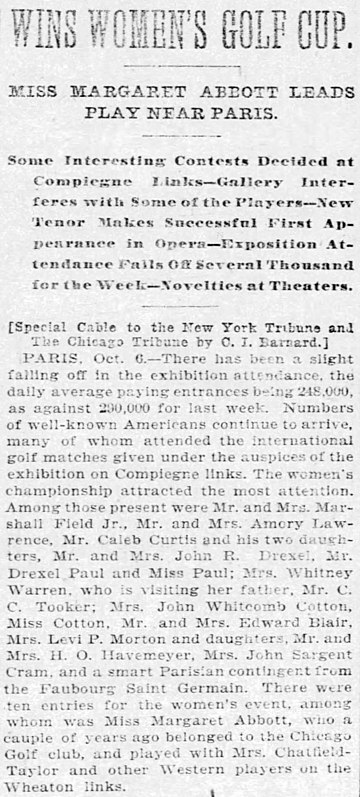
Margaret Abbott was an American amateur golfer at a time when “ladies” didn’t really play competitive sports. She was born in 1878 in India where her parents had moved because her father had business there. Her mother was equally accomplished, becoming a newspaper reporter and literary editor for many newspapers in the United States. And Margaret herself lived a privileged, full, and varied life before dying in the 1950s. She studied in the United States and abroad, but it was while her family lived in Chicago that Margaret first began to take golf seriously.

And she was naturally athletic. A couple of local amateur golfers (true gentlemen of the time refrained from being crass professionals, don’t you know) from the club where her parents were members took Margaret under their wings and taught her all they knew about the game. Under their tutelage, Margaret’s golf game rapidly advanced far beyond others her gender and years. She won several tournaments in and around Chicago and beyond and developed a reputation for being a fierce competitor.

Then, in 1899, Margaret and her mother traveled (by themselves! Amazing!) to Paris for the pair of them to study art. Margaret’s mother also used the time to pen a travel book for American women who had the same desire, entitled A Woman’s Paris: A Handbook for Everyday Living in the French Capital. The two women had a wonderful time, enjoying all that the fin de siècle era Parisian culture had to offer.

It was while the pair were in France in the summer of 1900 that they noticed a newspaper article stating that, in association with all that was going on in Paris that year, a golf tournament was open for any and all entrants. And there was indeed a great number of events happening in Paris that summer. The Paris World Fair was held that year. The French capital city hosted the second incarnation of the modern Olympics that summer as well. The city was filled with tourists from across the globe. And then here was this golf tournament. Now, Margaret’s mother was no slouch at golf, either, and the mother-daughter team decided to enter the tournament.

And Margaret won. By two strokes. And Margaret’s mother finished the tournament a respectable seventh. And, for her win, Margaret was awarded a beautiful porcelain bowl that had gilded embellishments around it. The story of this American girl winning the Paris golf tournament made the US papers, but the story was quickly forgotten.

Margaret got married eventually upon her return to the United States. She raised a family. She played some golf, but an old knee injury made her give up the sport. Almost thirty years after her death, her son, Philip, received a phone call from a professor at the University of Florida, a woman named Dr. Paula Welch. Dr. Welch asked Philip about his mother, about her life and then about what she told him of the tournament she won in Paris three-quarters of a century earlier.

Philip was surprised. His mother really hadn’t spoken much about it, he said sheepishly. I mean, he said, it was only another tournament, and she competed in many during that time. According to Philip, Dr. Welch was silent on the other end of the phone line for a moment. In fact, he wasn’t sure if the professor were still there. Finally, Dr. Welch spoke, and what she said stunned Margaret’s son.

“You mean your mother didn’t tell you that she was the first American woman to have won a gold medal in the Olympics?” she asked.

On an Imposter

Tom sat in the British trench with his friends and fellow soldiers, and he read a newspaper. It was 1917, on the Western Front, and the Great War raged across Europe and other places around the globe, making it the first truly world war. Tom had joined the British Expeditionary Force in the early days of the war. He was a Canadian, Tom was, and he was proud to serve King and Country.

An article in the paper caught his eye. It seems that a fellow Canadian, a celebrity, long-distance runner named Longboat, had enlisted in the war effort as well. Now, this was the period when track and field was a much more publicly popular sport than it is today. Crowds paid top dollar to watch races of all distances in much the way people today pay to witness boxing matches live. Anyway, this Longboat fellow had enlisted, the story said.

But Tom knew something wasn’t right about this story. First of all, the story said that this Longboat guy had enlisted not in Canada, but he had gone to the United States and had enlisted into the American armed forces (who were only then joining the war on the side of the Allies). Tom didn’t know that Canadians enlisting in the US Army was possible. Also, Tom knew first-hand what this Longboat fellow looked like, and the man who was depicted in the publicity photo in the newspaper was definitely not him.

You see, Tom himself had been known to run a race or two back in the time before the war. In fact, he was a “runner” for the British Army, dispatching messages from the front lines to the rear. It was job that required speed, certainly, but also incredible bravery because the runners were often exposed to gun and shellfire as they ran the messages back and forth.

So, when Tom saw the photo of this imposter Longboat guy, he was a little miffed. I mean, it was obvious that he was trying to get some cheap publicity by pretending to be the famous runner. Maybe, also, he thought he could get a cushy assignment in the military because of his fame. Who knows for sure why people assume others’ identities?

Tom told his friends in the trenches that he would try to get word through channels about this imposter. Being a runner who went back to Headquarters regularly, he had some connections there who might could get word to the Americans about this guy. Tom’s buddies in the trenches were skeptical. Why would the Americans believe the word of some guy in the British Army over the word of a man who said he was a world famous runner?

Tom smiled.

“Well, after all, I’m the real Tom Longboat.”

On an Unusual Protest

“There is no value whatsoever in this poisonous chicken soup.”

That is the official Chinese government response to a current but quiet and subtle protest in their nation. The protest is quite popular among the young adult population of China today. To try to understand it is to take a quick look at Chinese culture today and what brought it to this point of protest by the young people.

Hard work has always been valued by Chinese culture. The work ethic there makes the western Protestant work ethic look like bone idleness. Let’s also say here that competition for the best jobs in China is so fierce, so cut-throat, that any possible edge a worker can get will be used and exploited to first get and then keep a job. Towards that end, then, combined with the cultural demands to work hard, young people in China are expected to work incredibly long hours.

How long? Well, the government slogan for the Chinese labor force is a simple one: 996. That means that the minimum, the baseline for workers, is 9am to 9pm six days a week.

Yep. You heard me. And that then means that if a young worker wanted to show the boss that they were serious about the job, then they would work more than 996. How much more? No one knows the answer to that question definitively. It’s also known as the Wolf Culture, the idea of an employment version of kill or be killed. It’s an attitude shared by many other Asian countries. It’s why Squid Game resonates with them so much–they’re sort of living that on a day-to-day basis in their jobs.

And it’s killing young Chinese workers, both physically and emotionally. There’s been a shocking rise in reported suicides, depression, addictions, sleep deprivation, and other issues. It is now recognized as a national health crisis. The question is quickly becoming, as the young people see it, how do they respond to these increasingly unrealistic expectations on their work lives?

And the answer of many young people, their collective response, is what the Chinese government has officially called “poisonous chicken soup.”

These young people have decided to, in Chinese, tang ping.

What does that mean?

Well, you can’t imagine the shockwaves this simple act is sending throughout all phases of Chinese society. Employers are paralyzed with fear that they may have to either cut back production or work because they don’t have the manpower or, worse, they will have to allow workers to work fewer hours. The older generation can’t wrap their heads around the concept that younger workers simply don’t care about having a better life than they do. That mentality goes against all Chinese cultural norms, and such rebellion against the culture is seen as treason by the Chinese government.

Yet, the movement grows, ironically, more and more as a larger number of Chinese young people actually do less and less.

And what is tang ping?

Tang ping means to simply lie flat–as in staying home in bed and not working at all.

On His Brother’s Keeper

David is a kind man. He and his brother John grew up in the Chicago, Illinois area in the 1950s and ’60s to a working-class family who had immigrant ties to Poland. The family instilled strong academic performance from both boys. David showed promise as writer, and John was something of a math prodigy. From an early age, David learned to be grateful and to show that gratitude for the things he has and the life he leads. He studied at Columbia University and graduated in 1970.

David decided first to teach. He returned to the mid-west after college, landing a teaching gig at a high school in Iowa. He married a woman named Linda, and the pair eventually relocated to New York. There, David got involved in non-profits that targeted at-risk youth. He later became involved in anti-capital punishment groups but also advocated for the victims of violent crimes. Today, David and Linda are both Buddhists and practicing vegetarians.

John chose a different path in life. John went to another Ivy League school–Harvard. He then pursued his math studies at the University of Michigan, completing graduate degrees there including the receiving of a PhD in the late 1960s. Unlike David, John wasn’t great with words. In fact, he was considered to be a “walking brain” according to people who knew him.

By the age of 25, he was a professor at Cal-Berkeley. However, two years later, his lack of social skills had driven him out of teaching. He found himself back home with his parents in suburban Chicago. David tried to reach out to his big brother to see if he could help him learn how to negotiate the ins and outs of being a social person in the world. But John didn’t warm to David’s attempts to reach out. If it didn’t have to do with math, John wasn’t interested. David, being the kind person he is, felt in an odd way that he was the big brother and should be the one to step up to help John in life. But that was not to be.

Finally, John left his parents after staying pretty much in his room at home for two years. He went west, away from people, and isolated himself in the woods. David continued to try to reach out, but John never responded. It was years later that Linda, David’s wife, showed David a letter that had been published in the Washington Post. “This sounds like something your brother would write,” she said. David agreed. He contacted the paper in an effort to try to reach out to John. They referred him to other authorities. And because he then reached out to them, David was able to bring John back from his self-imposed exile in the woods.

And what David brought John to was prison. You see, the letter that Linda showed John in the Post was written by the man the FBI was seeking in connection with a series of bombings across the United States.

Yes, because of the intervention of his brother, Theodore John “Ted” Kaczynski, the Unabomber, was finally captured.