On a Pilgrimage

Paul’s dream his whole life was to visit Jerusalem. He grew up a good Catholic boy in Italy, born in the countryside about 130 years ago to upper middle class parents who had some landholdings. One of his brothers became an attorney, another became a politician. Paul wasn’t sure what he wanted to be as he grew up, so he received a general education from the local school. He finally found a home in a publishing wing of the Catholic Church. He also taught in Catholic schools and eventually became a secretary to a Cardinal.

But he was devoted to the Church and to God. The Holy Land, especially the city of Jerusalem, always called to him. For most of his life, work and his responsibilities kept getting in his way of making the pilgrimage to the place. Finally, at age 67, Paul decided that it was now or never. He boarded a jet in Rome and flew to Amman, Jordan. Now, in 1964, when Paul made his pilgrimage, that was the normal tourist route into Israel because Jordan controlled those areas where Paul wished to visit. In other words, the borders of all those countries have changed dramatically since then. At any rate, Paul made his way with a large group of other pilgrims across the Jordan River and entered Jerusalem for the first time, fulfilling his life-long dream.

And it was magical for him. He knew enough history to realize that what he was seeing wasn’t the way it was almost 2000 years earlier, but that didn’t matter to him. It was his connection with the earth in that spot, the spiritual connection he felt with the place rather than the buildings or stones or streets. He knew in his heart that he was seeing the same space if not the same city that his beloved Jesus had once seen, seeing the sky from the same spot on the globe as Jesus had done, and breathing the air where Jesus had once breathed.

And that was more than enough for him.

To show his thanks to the land and the people for allowing him to realize his greatest desire, Paul brought gifts that he left at the different shrines. He lit candles in the churches. He prayed in the chapels. And, even though he was older, he barely slept while he was there because of his excitement. He didn’t want to waste time sleeping, he told friends later.

And, while he had accumulated wealth during his life and work, Paul chose to wear simple clothing during the pilgrimage. He wanted to honor the simple man he admired so much. And, because he believed that Jesus spoke about peace and love, he made sure to leave olive branches at every stop he and his other pilgrims made.

You may wonder why Paul’s pilgrimage merits your attention here and now. Surely, Christian, Muslim, Buddhist, Hindu, and billions of other religious people make pilgrimages all the time. And you’d be right. Except Paul’s pilgrimage was the first of its kind.

You see, Paul’s pilgrimage in 1964–Pope Paul VI–marked the first time a Catholic Pope had ever visited Jerusalem.

On an Official Phone Call

In 1947, the United Nations considered an important and historic vote. They were deciding how to partition Palestine, choosing what land would be used to create the new nation of Israel–or even if such a new nation should be created. The reasons for the UN taking up such long-lasting and significant decisions can be debated, but, for the sake of brevity, its important to realize that powerful people sat on both sides of the issues. The fate of nations, economies, wars, and decades of violence (both past, present, and future) was at stake.

And both sides knew that the vote was going to be close. Many people wished that the Palestinians should be allowed the land to form their own nation. Others felt that the Jewish people both in situ and trying to reestablish their lives after the Holocaust in Europe should be granted the land to form their own nation. Tensions were high, especially when you consider that this was also at the height of the Cold War between the United States and the USSR. So, every vote would count in the UN General Assembly.

The President of Haiti at that time was a man named Dumarsais Estimé. The Hatian leader was sitting in his office one day before the UN vote when his secretary called him on his intercom. She informed Mr. Estimé that the President of the United States, one Harry S. Truman, was on the line. The president picked up the line and heard the mid-western crisp voice of the American President say, “Good afternoon, Mr. President, this is Harry Truman calling from Washington. How are you, sir?”

Now, President Estimé had never spoken to Truman in the two years the Missourian had been in the White House. To get a call at this time was surprising. The US did send financial help to the poor but strategically placed nation. Perhaps this is why Truman was calling, the president thought. “I’m fine, Mr. President,” he answered. “What can I do for you?”

Truman came right to the point. He told the Haitian leader that he wanted Haiti’s vote in the upcoming UN session to be for the creation of Israel. “Now, this is important to me, Mr. President,” Truman told him, “and I know you want to remain a friend of the United States. Don’t you?”

Dumarsais Estimé was stunned. Was this a veiled threat from the American leader? Was Truman dangling American aid to Haiti as bargaining chip to force Haiti’s vote in the General Assembly? In his office in Port-Au-Prince, Estimé stayed silent a moment. Truman waited, then said, “Mr. President? Are you there?”

“Yes, sir,” Estimé said.

“What do you think, Mr. President? Can you see your way to vote for Israel?”

“Yes, sir,” Estimé repeated.

“I appreciate it, Mr. President. I look forward to speaking to you soon. Thank you,” Truman said. And then the line buzzed as the connection was broken.

And the Haitian delegate at the UN indeed voted for the creation of Israel. As, as I said, the vote was close. The resolution passed by a three vote margin. Truman’s strong-armed tactics worked, apparently.

Except there was a problem.

Years later, in the Truman Library Archives, the following notation was found in one of the former president’s daily journals:

“Someone pretending to be me called the President of Haiti and made threats about the Zionist vote,” Truman wrote. “I have asked that we get to the bottom of this.”

To this day, we still don’t know who that person was.

On a Special Cemetery

The Key Underwood Memorial Graveyard sits under shady old hardwoods and pine trees in the northwest of Alabama, not too far from the towns of Florence and Tuscumbia and Muscle Shoals. It’s quiet there, largely, the silence punctuated now and then by the calls of mockingbirds and other songbirds of the region. All in all, it’s a lovely place for a graveyard.

The first burial there took place fairly recently as southern cemeteries go, the first burial occurring in 1937. A man named Key Underwood used land that had been an old hunting camp to bury the first body there, and the graveyard is therefore named after him. And that first burial set the standard for what bodies can be laid to rest under the quiet trees.

You see, Mr. Underwood set requirements for the occupants of the graveyard.

First of all, bodies laid to eternal rest there must have had specific jobs during their lives. And there must be witnesses that this particular work was performed when the body was alive. Finally, a member of the cemetery committee must view the remains before the burial to insure that the body fits the first criteria.

If those requirements sound odd, well, you’re not wrong.

Now, I will tell you that some of my earliest memories are of cemeteries in the south, specifically in Alabama and the Florida Panhandle. I recall slowly moving between the headstones with my mother and other relatives on Decoration Day, changing out the flowers on the graves, and hearing, as we paused at the stones, the stories of what food aunt so-and-so made that everyone loved and what uncle this-and-that did for a living. But the stories were all tinged with sadness, with a feeling of great loss.

Key Underwood didn’t want that. He wanted a celebration of life, of joy, of activity, and of celebration. One source describes the place as, “the only graveyard I’ve been to that was less an acknowledgment of death than it is a celebration of what almost certainly was…a damn good life.”

And so, it is a cemetery of joy. The headstones have no requirements for standardization; you will find everything from hand-made stones to formal granite as you would in any other cemetery. There’re not any height limits, either, although this place isn’t about having a showy grave. It’s about the life that was lived by the creature that lies beneath the sandy Alabama soil.

Today, songs and poems have been written about the place. The graveyard has been featured in a major Hollywood film. And, every Labor Day, a gathering and remembrance is held with live music and food; a family atmosphere permeates the event. And the 300-odd graves in the Key Underwood Memorial Graveyard are respected and honored and loved and celebrated by those who lost those buried there.

Because it’s not every day that your life is blessed by an honest-to-God coon hound.

On an Assassination Plot

Let’s call him Guido. That’s the name he adopted when he left his native country to go fight in the Spanish Wars. While there, Guido made a name for himself as being a brave and somewhat reckless fighter. He became radicalized there as well, learning to combine religious fervor with a desire to enact vengeance for what he perceived to be wrongs done to people of the same belief he had.

Upon return to his homeland after the war, Guido quickly found many people who agreed with him. However, the discussions he and his like-minded compatriots had were by necessity held in secret. The government’s agents were everywhere, and people who openly opposed the government’s public and religious policies were rounded up, imprisoned, and, often, executed. Those in power did not tolerate any opposition, obviously.

All of that made Guido and his confederates even more radical in their desire to fight against what they felt was their right to worship God they way they wanted. No one person or group or government had the ability to take that away from them. Meanwhile, their numbers were being whittled down by the government’s oppression. And, so, feeling that there was nothing left to do except to fight against this perceived evil, the group hatched a conspiracy.

Guido’s plan was the one that the conspirators accepted. His brainstorm was to plant a large bomb in the basement of a government building and strike at the seat of power in the nation. The bomb was planted. The timing was agreed upon. All that was lacking was the detonation. And that’s where the plan went awry. It seems that the plotters had warned several people who shared their same religious beliefs, sending letters telling them to stay away from the government building during such and such a day and time. One of the members of one of the households that received one of these letters promptly informed the authorities.

After thinking that the warning was a hoax at first, the government was shocked into reality when they found Guido and the bomb in the basement of the government building. He was arrested. The government questioned him at length, demanding that he reveal the names of his fellow conspirators. Guido refused. That’s when the jailors began the torture. Soon, Guido gave up his fellow plotters. We have only a few hints of how extreme the torture was, but we have a signature he made on a document soon after the torture–a confession, actually–and the name is barely legible. Eventually, he and all the others were executed, their bodies torn to shreds, and their names becoming a byword for what happens to traitors who try to overthrow a government.

And so, the plot was foiled, but only barely. If it had succeeded. then history might have been different. Because, you see, Guido and his group had planted a large amount of gunpowder beneath the English Houses of Parliament in 1605. And Guido is remembered today as England’s most celebrated unsuccessful assassin.

In fact, every November 5th since then, the United Kingdom remembers him by lighting fires and shooting fireworks on Guy–Guido–Fawkes Day.

On a Familiar Face

The late 1800s and early 1900s were the heyday of the popular magazine. Collier’s, Leslie’s, and the Saturday Evening Post were some of the more circulated magazines that featured popular opinion and news articles of the day. And, since putting photographs in print was still a novelty, the magazines hired graphic artists who generated images that captured the public’s attention (and dollar). In many cases, the artists became somewhat public celebrities themselves, earning good money and large followings. For example, Norman Rockwell and Charles Dana Gibson became rather well known for their art and artistic voices.

One of the most famous artists of the period was one James Montgomery Flagg. You know him best most likely as the man who created the famous “I Want You!” poster featuring the character Uncle Sam. We all know that character and how he is dressed in patriotic colors and a top hat, a thin man with a goatee and a grim face, a bony, almost accusatory finger pointing at the person looking at the poster.

Flagg created the character to accompany a story in one of the magazines about American preparedness (or lack thereof) during World War I. You see, the US didn’t take part in the first three years of that war; we didn’t join the fight on the side of the Allied Powers until the spring of 1917. When we did decide to enter the war, a rapid mobilization of personnel and materiel needed to be accomplished. Flagg’s commission for the magazine was to create an image that would speak to the nation’s need for everyone’s help in “making the world safe for democracy,” as President Woodrow Wilson put it.

So, Flagg wanted to embody the nation with the Uncle Sam image. The problem was–whom could he use as a model? He asked one of his elderly neighbors, a broad-shouldered gentleman with a long, bony finger, to act as the body’s model. That part was fine for Flagg. But the man’s face was all, well, wrong for the art. Flagg tried to show the man what he wanted, but it was no use. The man’s face was too round and not, well, righteously angry enough for the drawing Flagg had in mind.

Then he had a brainstorm.

And the resulting artwork became one of the most iconic posters in American History. The US Government War Department procured the rights to the picture to reproduce it as propaganda, to use it to do things like sell war bonds at home and encourage people to join the armed forces. There was something about that bony finger pointing at the viewer that demanded action, but it was the face, the grim determination that most Americans felt in joining the fight that really made Flagg’s poster speak to Americans then and now.

Because of the success of his artwork, Flagg was, for a time, the highest paid illustrator in the United States.

And whom did Flagg find to be the model for the determined Uncle Sam, the one that our enemies didn’t want to mess with?

Why, the model he chose was himself.

On a Hidden Past

Dennis Whiles met Jean Clarke at a YMCA dance near Norden, California, in the early 60s. Jean liked that Dennis was a good dancer, well-spoken (Jean said he sounded like he was always giving elocution lessons), a smart man, and a hard worker. Norden is a ski resort area in the “elbow” of California that borders Nevada. Dennis worked the winters there as a ski instructor (he was a natural on the slopes, it was said) and as a construction worker in the summers. Jean also admired the way Dennis interacted with the two children she’d had from a previous marriage. The pair decided to get hitched in 1964.

There was one thing that bothered Jean about Dennis, and that was that her new hubby was rather tight-lipped about his past and his childhood. What she was able to cobble together was that he had been raised in an orphanage. He said that the story he’d heard was that his mother and father had been killed in a car crash, and he was left. He told Jean that he was as mystified about his past as she was.

However, Jean wasn’t convinced. There were several “lost years” in the story Dennis told. For example, what did he do from the time he left the orphanage in the late 1930s until the early ’60s–a roughly 25 year gap in his timeline? What did he do in the war? Where did he live? Dennis wasn’t forthcoming about those details. He mostly shrugged off questions like those.

And then there was the issue of the passport. Dennis had a social security card and a drivers license, but he had no birth certificate. Without that, the man couldn’t get documentation that would allow the couple to travel overseas. They lived in Hawai’i for a time, but Jean wanted to go to Europe, and there was no way Dennis could join her. And he claimed to not know where or when for sure he was born. All of his was incredibly sketchy to Jean.

Finally, after 20 years of marriage, she’d had enough. She confronted Dennis. She told him that he was a good man and a good dad and a decent husband, but she was done. Then, she gave him an ultimatum: Either tell her the truth about his past, or she would leave him. Dennis hung his head. “I will tell you,” he promised, “but you can’t overreact.” Jean let out a full breath of air. “I promise,” she said. “I just want to know the truth; I have to know the truth.”

And so, Dennis Whiles told her his true story.

It began for him in 1945, at the end of World War 2. You see, Dennis Whiles wasn’t his real name, it was the name he took while crossing the United States after leaving the Army. It was the name of a man he’d worked for a while. And he’d been incarcerated in New Mexico for much of the war, too, he admitted. He told his wife that if she’d’ve paid any attention to the wanted posters at the local post office, that she might’ve seen his photo because he was on the FBI’s Most Wanted list for years.

Jean was shocked. She couldn’t put the man in front of her with the person described in the story. She was quiet for a moment, and then she asked, “So, who are you, really?”

“My name is George,” he said slipping into an accent. “George Gaertner. I was born in Germany, escaped from a German POW camp in New Mexico at the war’s end, and I never looked back.”

On Some Invented Words

She and I, former friends, found ourselves in a pickle. Our relationship had seen better days, that’s for sure. That when the green-eyed monster, jealousy, had raised its bedazzled head. The cold-blooded and hard-hearted rant it started came out of my mouth without my even realizing it. True, I was wearing my heart on my sleeve in that moment.

Oh, it was absolutely character assassination, no doubt about it. Did she deserve it? Arguably not; some would say that it was baseless, but my ranting had a certain feeling of vindication to it even though it was at the same time obscene. Someone who saw it might say I was rather sanctimonious and that my behavior was laughable.

The thing is, once you start publicly shaming someone, it becomes like an addiction. It feels so cleansing, so cathartic. Oh, some might label you zany for critically and verbally assaulting someone like that. And the object of your castigation, your verbal attack might see you as an arch-villain.

And if you happen to be an eyewitness to such an eventful tirade, if you happen so see such a sorry sight, you won’t soon forget it. The inaudible terror that flashes on people’s faces when they hear your screed is also something to behold. It can make your hair stand on end.

It’s even more terrifying when it happens in the workplace, as when a manager berates a worker. You feel for the employee as the manager swaggers over them publicly and verbally, knowing that the whole place has been made uncomfortable by the scene. If the person gets fired, then sometimes, you have the embarrassing scene of the watching the disheartened worker realize that the game is up. You see them gathering their belongings in a hurry and beating an inauspicious retreat.

You’re probably wondering what all this means, well, wonder no more. You see, all those words and phrases–and dozens more–were created by one man some 400 years ago. We use them today without a second thought.

But we wouldn’t have any of them without the majestic genius of the auspicious William Shakespeare.

On a Legendary Pope

The history of the Catholic Church for the past 1700 years is filled with stories of legendary/mystical/mythical people. This is one such legend.

Possibly.

I say “possibly” because there was a time in the history of the Church when not only were records scant and/or lost, but also a time when so much turmoil and change was happening in many different places that it is almost impossible to tell for certain who was who and what was what. And that brings us to the story of a pope, Pope John Angelicus. Pope John is supposed to have been the pontiff for only two years, from 855 to 857.

What makes his papacy questionable and likely the stuff of legend is that he wasn’t mentioned in many lists of popes of the Church for at least 350 years after he was supposed to have been made pope. The first time anyone included this Pope John on the list of church leaders is when a Frenchman, one Jean deMailley, commented on the short reign over the church by John. Within 100 years, other Church chroniclers included John Angelicus in their lists based largely on deMailley’s list.

The story goes that John came from the city of Mainz, and, as a teen, joined a monastery to follow a lover who also joined. Well, right away, we can see how some people then (and now, sadly) would object to such a narrative. John’s story was then considered to be true and history until the 1600s. At the same time, the Protestant Reformation was causing many across Europe to question the Catholic Church and its (often sketch) history. That’s when the Church began looking closely at anything that could be pointed to by Protestants as being false or fabricated by the Church, whether it be in the realm of theology or even the history of the popes.

And that brings us back to John Angelicus. The Church formally renounced the existence of John’s rule, thereby taking away one small but still significant bullet point that the Protestant movement could have used. The official Catholic line became that the list of popes moved from Pope Leo IV’s death in 855 to Benedict III receiving the keys to the papal kingdom that same summer of 855. That effectively closed out any possibility of another pontiff in between.

Of course, it could be that the Church also wanted to cover up who John Angelicus really was. That might have been the reason deMailley included his detailed description of John’s reign in the first place. You see, the reason that the story said John followed a lover into the monastery was that he was not “John” at all.

No, it seems that the legend is that John Angelicus was actually a woman, Joan Angelicus, who hid her gender and rose through the Church hierarchy to become the pope.

On the End of the Line

The little apartment above the barber shop is still there. Little has changed since 1960 at 716 East Gerrard Street on the edge of Toronto, Canada. In 1960, that’s where the Martemianoff Family lived. Constantine and his wife, Sinaida, had left eastern Europe decades ago and settled in the tight-knit immigrant community, finding the little upstairs apartment both affordable and convenient.

That summer, as the 1960 presidential election dominated the news, the elderly couple found themselves faced with a dilemma. A close friend of theirs, another immigrant, an old widow, needed their help. She’d buried her husband a few years before and had then suffered from a stroke earlier in 1960. After a stint in the hospital, it was determined that she could not take care of herself.

Now, Christian charity only goes so far in my book. The Martemianoffs had a similar give and take; they discussed at length what their obligations were before God and what they could do to help the widow, if anything. It was Constantine who suggested that they allow the now-bedridden old woman to move in for a time. Perhaps, he told his spouse, they could nurse her back to health enough that she could return to her own home and care for herself. Sheepishly, Sinaida agreed.

And so, the widow was released from the hospital and moved into the spare bedroom in the little apartment above the barber shop on Gerrard Street. And soon, any misgivings that either of the hosts may have held about helping the widow were dispersed. She needed care, certainly, but her attitude was bright and cheerful. She told Sinaida, “I always laugh; if I ever start crying, I may never stop!”

She was ever so grateful to the couple for their help and patience with her. There is, I’ve learned, good pride and bad pride. Bad pride is thinking that your crap doesn’t stink; good pride is holding your dignity when you’re in a dire situation. And that good pride, that’s what this widow woman had, the couple saw. Of course, they knew her fairly well already, but you never know what someone is truly like until you have to live with them and care for them day after day.

Sadly, despite her good attitude and the good care of the couple, the widow never recovered. She died a few weeks after coming into the Martemianoff’s home. And, perhaps, it’s fitting that Constantine’s house is where she died at age 79. After all, it had been his job several decades before to take care of the widow and her family when he and she were both young.

You see, Constantine had been a bodyguard for the Russian Imperial Family, and the widow who died in his spare bedroom above the barber shop was Grand Duchess Olga Alexandrovna, the last survivor of the line of the Romanov Dynasty.

On an Obscene Funeral Guest

Andrew Jackson spent his life collecting enemies. Few people in American History garnered as much hate as Old Hickory did (and still does, in some quarters). This was a man who grew up with a white-hot hatred for all things British (he and his family suffered at the hands of British soldiers during the American Revolution), all things associated with First Nations/Native Americans, and pretty much anything not White, Anglo-Saxon, and protestant.

And then there were the personal and political enemies he accrued in his lifetime. Jackson was the object of an assassination attempt while in the White House, in fact. He had fought several duels and carried a pistol ball in his shoulder for much of his adult life from one of these interactions.

On the other hand, many of the “common folk” of America loved him.

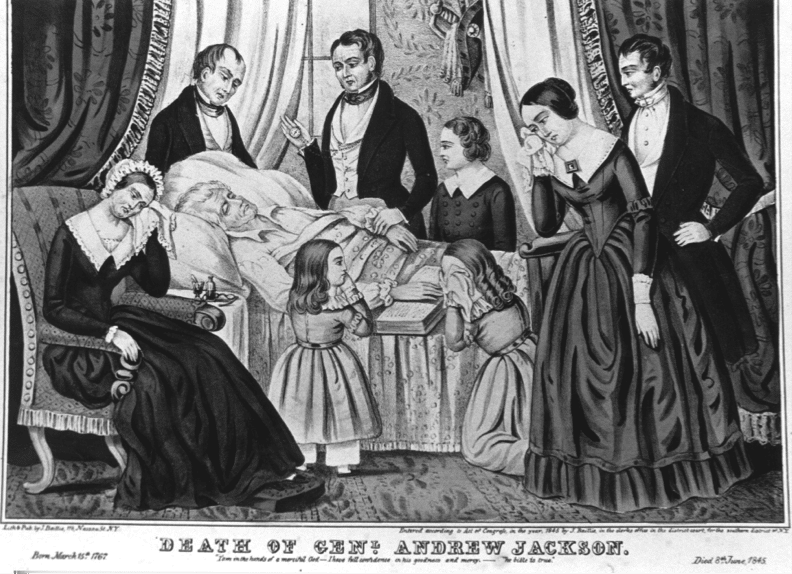
In fact the common folk flocked to the place where Jackson’s funeral was held at his house, the Hermitage, near Nashville, Tennessee. However, it was his close political friends and foes and friends who, by and large, were allowed inside the building at the funeral when the former general and president died in 1845. The event was hosted by the Rev. William Norment, a strict man of the cloth. In Rev. Norment’s recounting of that day, he spends a good deal of time describing an event that upset not only the minister but also much of the crowd inside the funeral at Jackson’s home.

If Norment’s notes are to be believed, the situation began when one of the mourners who was close to Jackson in life was brought into the room. It was before the sermon, and the group of prestigious guests were still gathering. This particular guest began to speak loudly about his hatred for Jackson.

Now, I’ve been to many funerals and have presided at several as well, and I’ve heard my share of whispers about the different deceased people. Some of the dead were described as being jerks in life, cheats, scoundrels, and worse, but none of those things were said out loud, in public, for all to hear.

But this was different. In this case, the funeral guest began to swear–loudly–about the dead man. He called Jackson every name in the book and some that weren’t even in the book, apparently. The crowd grew silent as the tirade continued. The screed lasted for several minutes. The good Reverend was shaken by the outburst. He motioned for a couple of Jackson’s pall bearers to remove the offender, but the source of the rude outburst was loathe to go. Finally, this particular funeral guest was forcibly removed from the room, and the funeral continued. But the damage was done. Many felt that the loud cursing at Jackson had cast a pall (no pun intended) on the proceedings. Newspaper accounts of the event highlighted this scene as well.

History has not recorded what happened to the offender afterward. We don’t know if anyone spoke to him or not, nor do we have proof of who took custody of him afterward.

All we know is that the solemnity of funeral of President Andrew Jackson was disrupted by the outrageous cursing of his pet parrot, Poll.